
📌 Quick Answer
Rising damp is the rise of water from the ground through the pores of a wall, up to a height of 1–2 metres, by capillary action. For a permanent solution, we recommend first stripping the damaged plaster and applying a breathable damp-proofing plaster (HydroFix), then, once the plaster has dried, forming a damp barrier in the wall with silane/siloxane-based chemical injection (DampStop D101). Paint, gypsum plaster or traditional methods alone do not work.
Have you noticed rising stains, blistering plaster and a musty smell on the walls of your home? These are most likely the symptoms of a rising damp problem. A significant proportion of buildings in Türkiye — especially on ground and basement floors — face this problem. Rising damp is a problem that causes serious damage to thousands of buildings every year and is often made worse by the wrong interventions.
So what exactly is rising damp, why does it form and — most importantly — how is it solved permanently? In this comprehensive guide we will cover in detail everything you need to know, from the scientific background of rising damp to its symptoms, from why traditional methods fail to modern solutions. Our aim is to help you diagnose your damp problem correctly and reach the most suitable permanent solution for you.
What Is Rising Damp?
Rising damp is the upward movement of water in walls, by capillary action, as it passes from the ground into the building material. In the language of physics this is called capillary suction or capillary rise. Just as a sugar cube absorbs tea when it touches it, porous building materials such as brick, stone and mortar absorb the moisture in the soil and carry it upwards.
This physical event depends on the pore size of the material and the surface tension of the water. The smaller the pores, the higher the water rises. In a standard brick wall, rising damp usually rises to between 0.5 and 1.5 metres; but under the right conditions it can exceed 2 metres. In limestone and some natural stones this height can be even greater.
Rising damp is not merely an aesthetic problem. It is a complex problem that damages the internal structure of the building material, reduces the strength of load-bearing elements and seriously lowers indoor air quality. Left untreated, it leads to structural deterioration, chronic health problems and high economic losses. That is why early diagnosis and the correct intervention are critically important.
How Does Capillary Action Work?
Capillary action (capillary effect) is the rise of liquids against gravity in narrow tubes or porous materials. It occurs when the liquid's surface tension and the force of adhesion to the material surface are greater than the force of gravity.
In building materials, pore diameters are on the order of micrometres. In channels this small, water can rise metres despite gravity. The height of the water's rise is calculated with the following formula: h = 2γcosθ / (ρgr) — where γ is the surface tension of the water, θ is the contact angle, ρ is the density of the water, g is the acceleration due to gravity and r is the pore radius.
In the real world, the theoretical maximum height to which water can rise is balanced by the rate of evaporation. Rising-damp equilibrium is reached at the point where the amount of water evaporating from the inner and outer faces of the wall equals the amount being drawn up from below. This equilibrium point varies with the season, the ambient temperature and ventilation conditions.
The Causes of Rising Damp
For rising damp to occur, several factors need to come together. Here are the most common causes:
1. High Groundwater Level
If the groundwater level is high on the land where the building is constructed, the foundations are in constant contact with water. This is very common especially by the sea, in river beds, on former lake areas and on alluvial ground. In coastal cities such as Istanbul, İzmir, Antalya, Mersin and Trabzon, the groundwater level is quite high in many areas.
Seasonal changes also play a part. In the winter and spring months the groundwater level rises with the rainfall, and in the summer months it falls. For this reason the symptoms of rising damp can fluctuate seasonally — but this does not mean the problem has gone away.
2. Inadequate or Damaged Horizontal Damp-Proofing (DPC)
In modern buildings there is a horizontal damp-proof layer (DPC — Damp Proof Course) at foundation level. This layer is usually applied as a bituminous membrane or plastic strip and prevents the moisture in the soil from passing into the wall. In older buildings, however, this layer is either completely absent or has deteriorated over time. In the vast majority of buildings constructed before 1980 there is no effective DPC.
In some old buildings, slate slabs were used as a DPC. These slabs can crack over time, slip out of place or lose their integrity through structural movements such as earthquakes.
3. Capillary Suction (Capillary Action)
The porous structure of building materials allows water to rise despite gravity. Materials such as brick, breeze block, natural stone and lime mortar all absorb water. Lime-based mortars in particular draw up far more water than cement-based mortars. The water absorption capacities of different materials:
- Lime mortar: High porosity, absorbs a great deal of water
- Fired brick: Medium-high porosity, varies with quality
- Natural stone (limestone): High porosity
- Natural stone (granite): Low porosity, relatively resistant
- Concrete: Low-medium porosity, but takes in water through cracks
4. Raising of the External Ground Level
Fill, paving, asphalt or landscaping work carried out around the building afterwards can raise the ground level. In this case the original DPC line ends up below ground and loses its function. This problem is seen frequently in many urban regeneration areas, in old neighbourhoods and after road resurfacing works.
5. Faulty Drainage and Water Management
If there is inadequate drainage around the building, rainwater and surface water collect at the foundations. This both increases rising damp and causes lateral water pressure. Blocked gutters, broken pipes, incorrectly graded ground and an inadequate drainage system are commonly encountered drainage problems. On sloping land in particular, water from higher ground being directed towards the building's foundations is a common problem.
The Signs of Rising Damp
Detecting rising damp early significantly lowers the cost of intervention. Here are the signs to watch for and a detailed explanation of each:
Blistering and Crumbling Plaster
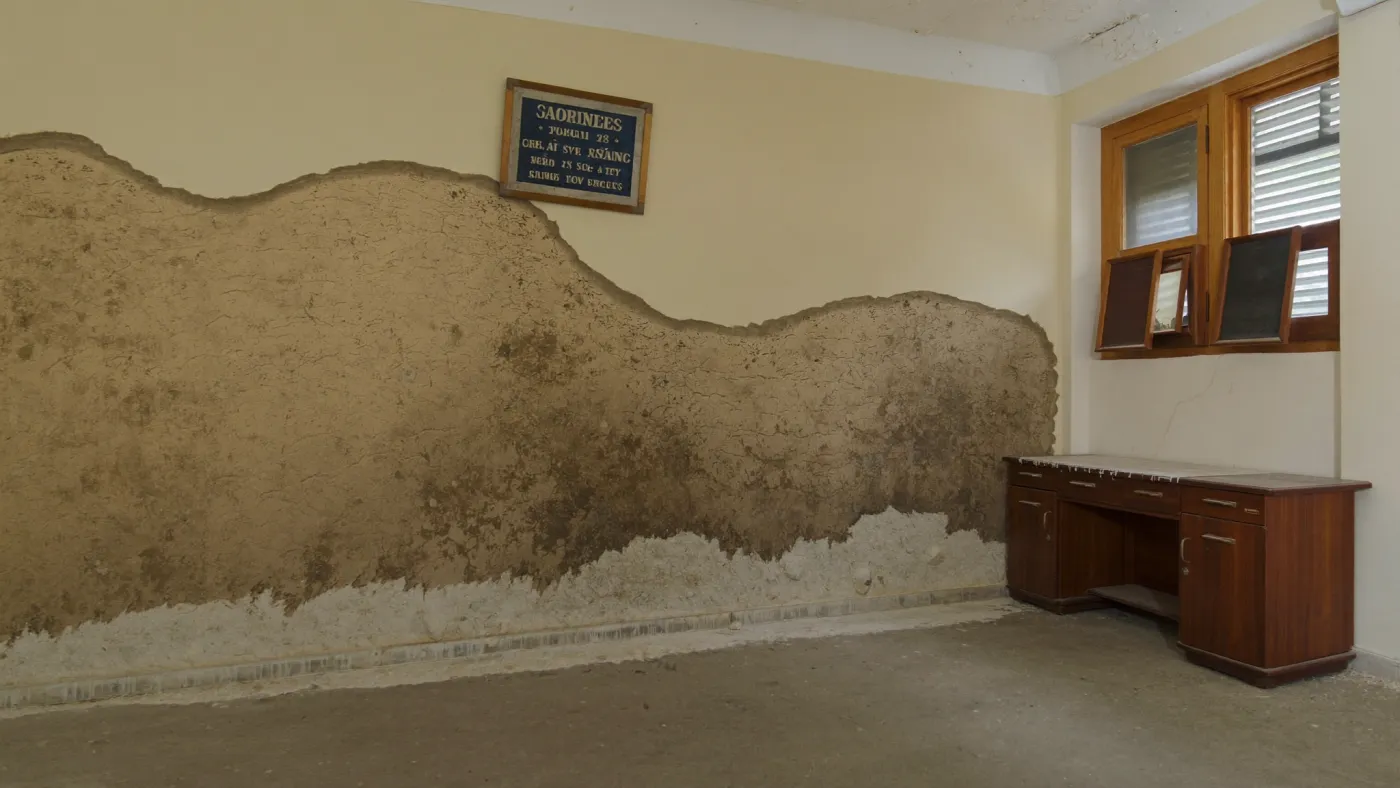
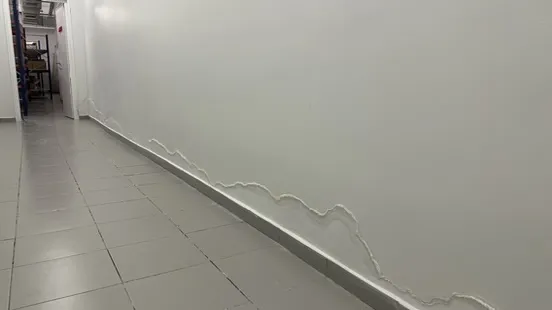
The most obvious sign of rising damp is the plaster blistering, cracking and eventually crumbling in the lower parts of the wall. As the water dissolves the salts in the plaster, it moves them. When the water evaporates, the salts crystallise and expand, bursting the plaster from within. This process continues as moisture absorption in winter and evaporation in summer, and with each cycle the damage increases a little more.
Salt Efflorescence
Deposits form on the wall surface as white powder or crystals. These are mineral salts from the soil — sulfates, nitrates and chlorides — which rise with the water and accumulate at the point where the moisture evaporates. These marks become especially pronounced in the winter months and in poorly ventilated rooms. Salt build-up is not merely an aesthetic problem; sulfates can chemically break down cement-based plasters.
Mould and Fungal Growth
Wall surfaces that stay permanently damp create an ideal environment for mould and fungal spores. Black, green or white mould stains usually start in corners, behind furniture and in areas with poor ventilation. Mould spores can cause serious respiratory illnesses, allergic reactions and asthma attacks. The World Health Organization (WHO) defines damp indoor environments as a significant public health risk.
Musty Smell and Stuffiness
In rooms affected by rising damp there is a sharp, musty, earthy-smelling atmosphere. This smell is an indicator of active damp and biological decay in the space. Although opening a window to ventilate reduces the smell temporarily, the smell returns as long as the source of the damp is not cut off.
Peeling Paint and Blistering Wallpaper
Interior paint shows staining, discolouration, blistering and peeling. Wallpaper lifts at the edges, swells and falls away. Freshly painted walls deteriorating again within a few months is a strong signal that there is an underlying rising-damp problem. At this point most homeowners have the wall repainted — but this is not a solution, it is a waste of money.
The Wet Line (Tide Mark)
A distinct wet-dry boundary forms on the wall. This line is usually between 30 cm and 150 cm from the ground and its height can vary with the season. In the summer months the line drops because evaporation increases; in the winter and spring months it rises. Salt deposits are usually seen above the tide mark.
Rotting of Timber Elements
Skirting boards at the base of walls, door frames and floor joists are affected by rising damp and rot. Timber becomes open to fungal and insect attack once its moisture content rises above 20%. Especially in old buildings, the ends of timber floor joists embedded in the wall can rot due to rising damp, causing dangerous structural weakening.
In Which Buildings Does Rising Damp Occur?
Basements
Basements below ground are the areas where rising damp is seen most intensely. Walls buried in the soil are exposed both to lateral water pressure and to damp rising from below. In basements there is usually more than one source of damp at once, and an expert assessment is needed for a correct diagnosis. Many basements add a condensation problem on top, due to inadequate ventilation.
Ground Floors
In buildings with no DPC or a deteriorated one, ground-floor walls are directly affected. Rising damp can be seen especially on internal walls — even on partition walls with no contact with the external façade — because the moisture beneath the floor slab reaches the internal walls too. Because living spaces on the ground floor are directly affected, the health risks are higher.
Historic and Old Buildings
Ottoman-era buildings, Republican-era buildings, old village houses, historic mosques, churches and caravanserais are the buildings most affected by rising damp. These buildings usually have no damp-proofing at all, and the materials used — natural stone, lime mortar — absorb water easily. In historic buildings, invasive methods may be restricted due to conservation legislation — in which case chemical injection is an ideal solution that requires minimal intervention to the structure.
Industrial Buildings and Warehouses
Factory buildings, warehouses and workshops are usually constructed with simple foundation systems. In these buildings rising damp causes both material damage and damage to the goods stored inside. In areas where moisture-sensitive products such as food, textiles, paper and electronics are stored, rising damp can lead to serious economic losses.
Rising Damp Solution Methods
Various solutions for rising damp are offered on the market. But they are not all equally effective. Let us examine in detail the advantages, disadvantages and areas of application of each method.
Chemical Injection (DampStop)
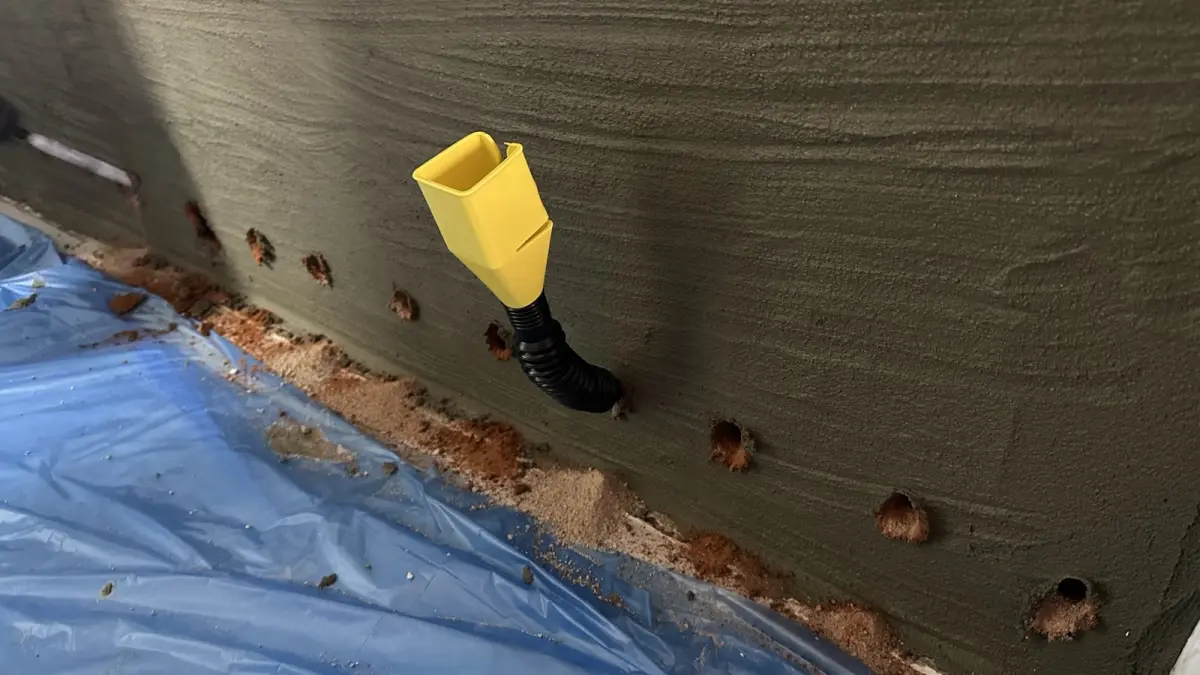
Today, the most effective and most widely preferred method for solving rising damp is chemical injection. In this method, holes are drilled at regular intervals in the lower part of the wall and a special silane/siloxane-based solution is poured into them with a funnel (no pump needed). The solution spreads within the wall, fills the pores and forms a water-repellent barrier. This barrier is the modern equivalent of a DPC (horizontal damp-proof layer).
The DampStop chemical injection system is a professional product developed for this purpose. It forms a hydrophobic (water-repellent) layer within the wall. The silane/siloxane-based active ingredients form a chemical bond on the inner surfaces of the pores, providing permanent water repellency. Applied correctly, it cuts off the source of the damp and requires no energy source.
Advantages:
- A definitive solution — requires no maintenance after application
- Does not damage the structure — applied with minimal intervention
- Can be used safely in historic buildings
- Cost-effective — the most economical solution in the long run
- Short application time — 1–2 days on average
- Proven technology — a successful track record of over 50 years in Europe
Damp-Proofing Plaster (HydroFix)
Damp-proofing plaster is a supporting product in the rising-damp solution. It is applied before the chemical injection, in place of the stripped damaged plaster; the injection is carried out once this plaster has dried. Unlike normal plaster, damp-proofing plaster evaporates excess moisture without holding it within itself and is resistant to salt crystallisation.
HydroFix damp-proofing plaster, thanks to its highly porous structure, allows the wall to breathe while providing protection against salt damage. Thanks to its special additives, it withstands the expansion pressure of salt crystals and does not crack. Used together with DampStop injection, it forms a complete solution system.
The Damp Box (Nem Kutusu) System
The Damp Box carries water reaching the foundation and rising in the columns back into the ground. DampStop and HydroFix work on wall elements (brick, aerated concrete, concrete block); if there is damp throughout the building, or damp also appears at the base of columns and in reinforced-concrete sections, the Damp Box is added and together the three make up the triple system.
Electro-Osmosis Systems
Electro-osmosis is a method that aims to push water molecules downwards by sending a low-voltage electric current through electrodes placed in the wall. There are two types, active and passive. Although it seems logical in theory, it is controversial in practice:
- Requires a constant electricity supply — the effect ends when the power is cut
- Inconsistent results have been reported in scientific studies
- High installation cost
- Requires regular maintenance and monitoring
- Its effectiveness is significantly reduced in salty environments
- Risk of corrosion in structures containing metal reinforcement
For these reasons, chemical injection is a more reliable and proven alternative to electro-osmosis.
Traditional Methods and Why They Don't Work
Many homeowners, and even some tradespeople, try the following methods to “solve” rising damp:
- Waterproof paint: It does not stop the passage of moisture, it only hides the symptom. The moisture building up behind it bursts the plaster along with the paint. Moisture build-up beneath the paint accelerates even further.
- Cement render: Because of its non-porous structure it traps the moisture. The moisture seeks a way out through other points and the problem spreads over a wider area. In addition, cement render breaks apart quickly along with the salts it takes in.
- Gypsum plaster: When it comes into contact with water it deteriorates and swells quickly. Gypsum should never be used on walls with a damp problem.
- Wallpaper and polystyrene cladding: It ignores the source of the damp. By creating a closed, damp, dark environment behind it, it sets the stage for mould growth. It increases the health risk.
- Internal insulation boards: Bonded insulation boards cannot adhere to a wall with a damp problem, and they then create a condensation and mould problem behind them.
All of these methods try to treat the symptom; they do not address the source. In a rising-damp problem, the permanent solution is to stop the mechanism that draws the moisture into the wall.
Solving Rising Damp with DampStop Injection: Step by Step
A professional chemical injection application consists of the following stages:
Step 1: Diagnosis and Measurement
First, the moisture level and height are determined with a wall moisture meter. It is confirmed that the source of the moisture is rising damp — it is very important not to confuse it with condensation or a leak, because the solution for each is different. The salt concentration in the wall and the type of material are also assessed. If necessary, the exact moisture ratio is determined with a carbide test.
Step 2: Removing the Plaster
The plaster in the affected area is removed up to at least 30 cm above the damp line, exposing the wall surface. This stage is necessary to remove the salt-contaminated plaster and to increase the effectiveness of the injection. Since the removed plaster is salty, it is treated as ordinary construction waste.
Step 3: Applying the Damp-Proofing Plaster
Once the plaster has been removed, and before the injection, HydroFix damp-proofing plaster is applied. Why this order? Stripping plaster can break open the cells of the bricks; if you inject first, the solution runs out through those breaks. If the plaster goes on first, the injection stays inside the brick without overflowing. The damp-proofing plaster is applied in two coats: the first coat (the base coat) provides an even surface, and the second coat (the finishing coat) gives an attractive appearance. Each coat is 2–2.5 mm thick, 3–4 mm in total; the second coat is applied after 6–8 hours. The damp-proofing plaster evaporates the remaining moisture while also protecting against salt damage. Full drying takes 24–48 hours.
Step 4: Drilling
Once the damp-proofing plaster has dried (24–48 hours), holes 14 mm in diameter are drilled in the lower part of the wall — at a height of about 10 cm from the ground. The holes should be at roughly 10 cm intervals and to a depth of about 80% (4/5) of the wall thickness. The drilling angle is set downwards (30–45°) so that the chemical can disperse with the help of gravity. On double-leaf walls, they can be drilled from both faces.
Step 5: Injection
The prepared DampStop solution (1 part concentrate + 9 parts clean water) is poured into the holes with the funnel supplied in the kit; no pump is needed. A low-pressure injection pump is optional and only for professional, fast application; it is not included in the kit. The solution spreads within the wall, fills the pores and forms a water-repellent barrier. Each hole is given enough solution for the wall thickness (ready-to-use solution: about 1.5 L per metre for a 10 cm wall, 2.25 L per metre for a 15 cm wall). On low-absorbency walls such as aerated concrete or solid concrete, a small amount is poured into each hole, a second round follows 10–20 minutes later, and the rounds are repeated until the wall is saturated. Solution seeping from neighbouring holes is a sign that the barrier is forming.
Step 6: Waiting, Filling the Holes and Drying
After injection, wait at least 48 hours, then fill the holes with plaster or mortar. The moisture inside the wall can take between 4 and 12 weeks to come out, depending on the wall thickness, the type of material and the surrounding conditions. As a general rule, about 1 month of drying time is allowed for every 25 mm of wall thickness. Ventilation is very important during the drying process — the time can be shortened by using dehumidifiers. Painting comes last: use a breathable (diffusion-open) paint — plastic-based paints should be avoided.
Will you carry out the application yourself, or get professional support? To find out how much product you need, you can fill out our Request a Quote form.
The Cost of Rising Damp and Estimating It
The cost of solving rising damp depends on many factors:
- Affected wall length: The total length, in metres, to be injected
- Wall thickness: Thick walls (40 cm and over) require more product
- Wall material: Stone walls, brick and breeze block have different absorption rates — stone walls consume the most product
- Damp level: In cases of heavy damp, a double row of injection may be needed
- Plaster area: The square metres to which damp-proofing plaster will be applied
- Labour: The cost of applying it yourself or of a professional team
As a general reference, for a standard ground-floor flat (about 20 metres of wall length, 20 cm thick), the cost of DampStop injection is lower than the amount you would spend over 2–3 years with traditional methods (the cycle of hacking off and redoing plaster). What is more, while injection provides a permanent solution, traditional methods incur a cost again every 1–2 years.
To get a cost estimate tailored to your project, you can fill out our Request a Quote form or send us photos of your wall through it to request a free online analysis.
Frequently Asked Questions
Does rising damp go away on its own?
No. Rising damp is a structural problem and, if not addressed, it worsens over time. In the summer months the symptoms may ease because evaporation increases, but the problem does not disappear. With each winter cycle the damage increases a little more and the affected area grows.
Is rising damp harmful to health?
Yes. Permanently damp environments set the stage for mould and fungal growth. Mould spores can cause respiratory infections, allergic reactions, asthma attacks and skin irritation. Children, the elderly and people with weakened immune systems are especially at risk. The World Health Organization has reported that the risk of respiratory illness for people living in damp buildings increases by up to 50%.
How long does chemical injection last?
A chemical injection carried out with quality products and the correct technique cuts off the source of the damp by forming a water-repellent barrier within the wall. DampStop's silane/siloxane-based formula is resistant to UV, biological decay and chemical reactions. It requires no maintenance after application. Silane/siloxane-based injection has been used in building protection in Europe since the 1970s.
Can we stay in the house during the injection?
Yes. The chemical injection application is a relatively quiet and clean process. There is short-lived dust and noise during the drilling stage, but it does not seriously disrupt daily life. The injected chemical is odourless and non-toxic.
Does rising damp only occur in old buildings?
No. It can occur in new buildings too. An incorrectly installed DPC, a damaged waterproofing membrane, cracks formed during construction or a subsequently raised ground level can all cause rising damp in new buildings. There are even cases in some new buildings where the DPC was never installed or was pierced.
If I just apply damp-proofing plaster, will the problem be solved?
Damp-proofing plaster alone does not solve rising damp. Damp-proofing plaster is a complementary product — it is applied in place of the stripped plaster; the injection that cuts off the moisture at its source is carried out once this plaster has dried. Simply replacing the plaster without cutting off the source leads to the same problem recurring within a few months. It is like lowering a fever without treating the illness.
Conclusion and Professional Support
When ignored, rising damp is a problem that causes serious harm to both the building and health. Traditional methods — waterproof paint, cement render, gypsum plaster — only hide the symptom and cause the problem to grow. These “solutions” repeated every year both drain your budget and cause additional damage to your building.
The permanent solution is to cut off the moisture at its source. First strip the damaged plaster and restore the wall with HydroFix damp-proofing plaster; once the plaster has dried, you can form a permanent damp barrier in your wall with DampStop chemical injection. This two-part system solves the rising-damp problem at its root and prevents its recurrence.
If you would like to estimate how much material you need for your project, you can fill out our Request a Quote form. For a free online analysis, send us photos of your wall through the same form — our technical team will assess them remotely and suggest the most suitable solution as soon as possible.
Looking for a solution to your damp problem?
Our expert team is ready to offer you the most suitable solution.