Salt converter and neutraliser
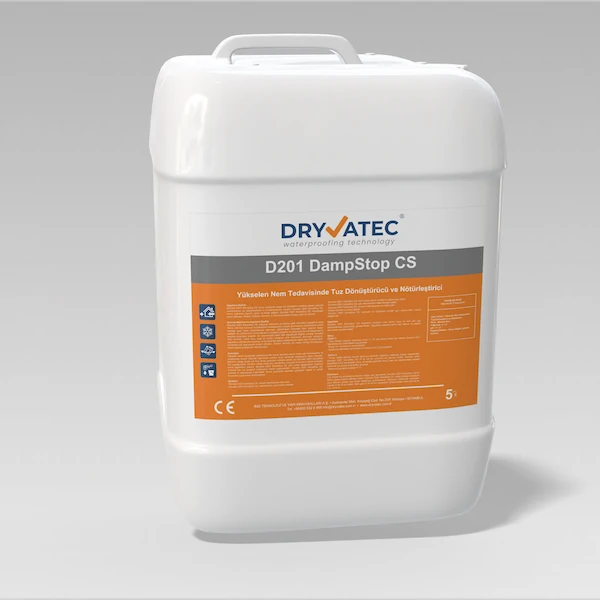
A solvent-free liquid surface treatment that neutralises the hygroscopic salts left in the wall by rising damp, converting them into harmless, water-insoluble compounds. Water rising by capillary action carries nitrate, sulphate and chloride salts up through the wall; as the water evaporates at the surface the salts stay behind and accumulate. These salts are hygroscopic — they draw moisture from the air. That is why the wall surface can stay damp even after the injection barrier has stopped the water from rising. D201 CS breaks that chain.
Fluosilicate-based salt converter
Colourless liquid
≈ 1.1 g/cm³
Salt neutralisation
≈ 1.7 (acidic)
≈ 0 °C
Spray or injection
1:1 with water (optional)
15 – 30 minutes
≈ 24 hours
Min. +5 °C
Non-flammable (solvent-free)
1.0 – 1.5 L/m²
24 months
1 L · 5 L · 20 L
Values are typical figures obtained at +23 °C / 50% relative humidity.
D201 CS is not a standalone solution. The correct order is: DampStop injection → D201 CS salt neutralisation → HydroFix damp-proofing plaster. On heavily salt-laden walls, skipping this step means the new plaster blisters within a few months.
No, that reverses the order. First stop the water from rising, then neutralise the residual salt.
No. The product cannot penetrate the pores, stays on the surface and the reaction remains incomplete. The surface must be dry.
No. If the surface is left before saturation, part of the salt stays active. Allow about 24 hours between coats; saturation is reached when the product begins to pool on the surface during the final coat.
Remove it from the area. The debris is salt-laden; left in place it re-contaminates the new plaster.
Contact us for detailed information, consumption figures and a price quote for D201 DampStop CS.