
What Is Capillary Action?
Capillary action is the phenomenon of liquids moving upwards inside narrow tubes, channels or porous materials in spite of gravity. This physical phenomenon appears in many places in everyday life: a paper towel absorbing water, a wick feeding a candle, plants carrying water from their roots to their leaves and, unfortunately, buildings drawing damp from their foundations into their walls.
The term capillary action comes from the Latin word "capillaris" (thin as a hair) and was first used to describe the rise of water in fine glass tubes. In building science, this effect is the fundamental mechanism that causes groundwater to rise within a wall through the porous structure of the wall materials. This is the science behind the rising damp problem, and for a solution to be effective this mechanism must be understood correctly.
In this article we will address the physical basis of capillary action, its mechanism of operation in a wall, the factors that affect it, and the solution principles developed on the basis of this knowledge. For a general definition, symptoms and solution methods of the rising damp problem, you can refer to our article What Is Rising Damp?
The Physical Basis: Adhesion and Cohesion
To understand capillary action, you need to know two fundamental molecular forces: adhesion (sticking to another surface) and cohesion (internal bond).
The Adhesion Force
Adhesion is the attractive force between molecules of different types. Water molecules sticking to a glass surface, to paper or to brick occurs thanks to the adhesion force. Because water is a polar molecule, it can form strong adhesive bonds with many surfaces. A drop of water spreading out on a glass surface is the result of the water forming strong adhesive bonds with the glass.
The Cohesion Force
Cohesion is the attractive force between molecules of the same type. Water molecules holding on to one another, creating surface tension and gathering into droplets are the results of the cohesion force. Cohesion enables water to maintain its own internal integrity.
The Capillary Rise Mechanism
Capillary rise occurs in situations where the adhesion force is greater than the cohesion force. In a narrow channel or pore, water molecules stick to the channel wall (adhesion) and also pull up the water molecules coming after them (cohesion). This pulling process continues until it is balanced by the force of gravity.
According to the laws of physics, the height of capillary rise depends on the following factors:
- The surface tension of the liquid (the higher it is, the greater the rise)
- The channel diameter (the narrower it is, the greater the rise)
- The density of the liquid (the lower it is, the greater the rise)
- The contact angle (an indicator of the liquid-surface interaction)
According to this formula, in very fine pores water can theoretically rise metres high. Indeed, in nature, trees use exactly this mechanism to carry water from their roots up to their leaves tens of metres high (in trees, transpiration also plays a role in addition to capillary action).
How Does Capillary Action Work in a Wall?
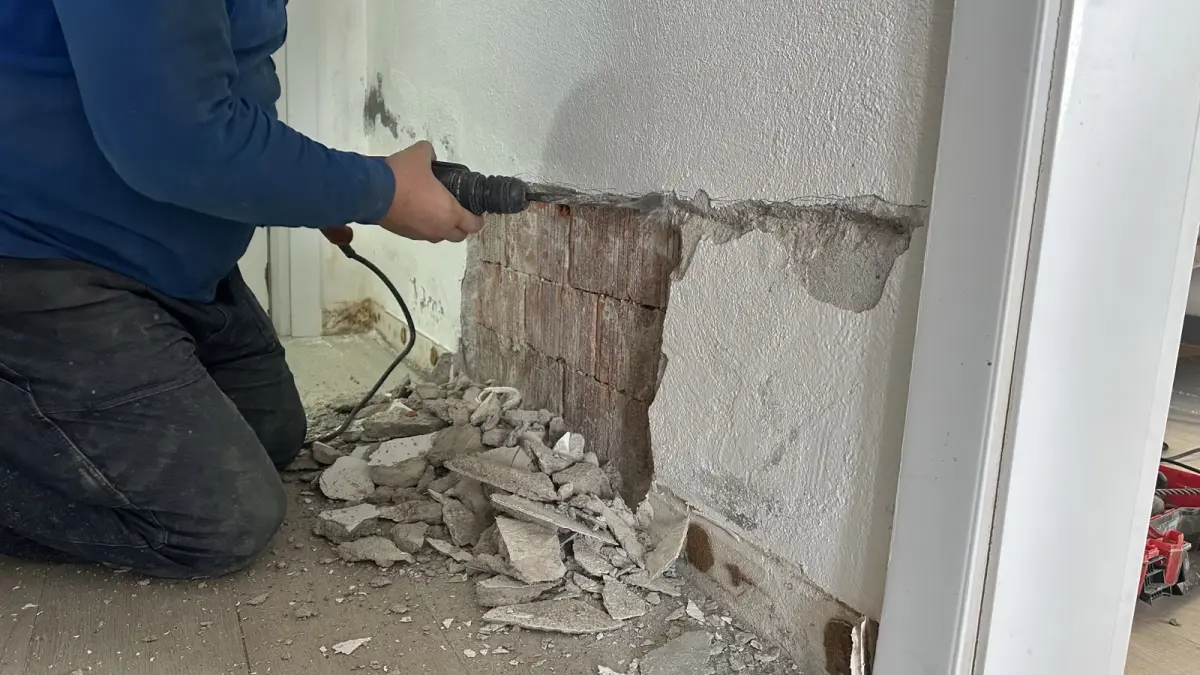
The building materials brick, mortar, natural stone, pumice block and concrete have a porous structure at the micro level. These pores form thousands of small channels through which water molecules can move by capillary action.
Porous Structure
A brick has a roughly 20-30% porous structure. This means that between one-fifth and one-third of the brick's volume consists of micro-channels filled with air or water. Mortar (the jointing material) has a porosity of between 15-25%. These pores are fine channels with diameters at the micrometre level and are the ideal size for capillary action to take place.
The Journey of the Water
Water at ground level comes into contact with the wall material at the lower part of the foundation. Capillary action draws this water upwards through the pores. The water rises by passing from one pore to another, following a maze-like path. This journey is slow; but it is continuous. As long as the groundwater source is uninterrupted, the capillary rise continues.
The Equilibrium Height
Capillary rise is not infinite. At a certain height, a balance forms between the capillary attraction force and gravity and evaporation. This equilibrium height depends on the wall material, the pore size, the ambient temperature and the ventilation conditions. Typically in brick walls this height varies between 0.5 and 1.5 metres. However, under some conditions (very fine-pored stone, high water pressure, poor ventilation) cases exceeding 2 metres have also been reported.
Salt Transport
Capillary action does not carry only water. The water in the ground contains dissolved minerals and salts. As the water rises by capillary action, it carries these salts along with it. When the water evaporates at the wall surface, the salts remain behind and form a white layer (efflorescence). These salts can create crystallisation pressure and break up the wall material from within. This means that rising damp creates not only wetness but also mechanical damage.
Factors Affecting Capillary Rise
Material Porosity
Different building materials have different porosity rates and pore size distributions. If we compare materials in terms of capillary rise, in fine-pored materials the water can rise higher but the speed is slower. In coarse-pored materials the speed is higher, but the rise is limited. Brick, having a medium porosity, is one of the materials most prone to rising damp in terms of both rise height and speed.
Water Pressure
The higher the groundwater level, the more the water pressure applied to the foundation increases. In addition to capillary action, this pressure causes the water to be actively pushed into the wall. During periods of heavy rainfall the groundwater level rises temporarily, and this leads to a seasonal increase in wall damp. High groundwater levels are a common problem, especially in the Black Sea, Marmara and Aegean regions of Türkiye.
The Effect of Salts
Salts dissolved in water affect capillary rise in a complex way. Salts change the surface tension of the water and affect the evaporation rate. In addition, salts crystallising in the wall pores disrupt the pore structure and over time can cause the pores to widen or become blocked. This means that capillary action is a dynamic process that can change over time.
Temperature and Ventilation
The ambient temperature and ventilation conditions directly affect the rate of evaporation. High temperature and good ventilation increase evaporation from the wall surface. While this reduces the build-up of moisture on the wall surface on the one hand, on the other hand it causes the capillary attraction to continue (new water is drawn up to replace the evaporated water). Low temperature and poor ventilation set the ground for moisture to build up within and on the surface of the wall, for mould growth and for structural damage.
Moisture Level Measurement Methods
To diagnose the rising damp problem correctly and to assess the effectiveness of the solution, the wall moisture needs to be measured. Several different measurement methods are available.
Moisture Meter
Moisture meters working on the principle of electrical resistance or capacitance measure the moisture level on the wall surface quickly and without damage. Pin-type moisture meters determine the moisture level by measuring the electrical resistance between two pins pressed into the wall surface. Non-invasive models measure with electromagnetic waves. These devices offer affordable options for DIY users and are ideal for monitoring the effectiveness of the application.
Calcium Carbide Test
It is based on the principle of reacting a sample taken from the wall with calcium carbide. The moisture level is calculated by measuring the pressure of the acetylene gas produced. This method gives more reliable results than surface moisture measurements because it measures the moisture in the inner part of the wall. It is preferred in professional applications.
Gravimetric Method
It is the most accurate moisture measurement method. The moisture level is calculated from the weight difference by weighing a sample taken from the wall, drying it in an oven and weighing it again. Because it requires a laboratory environment it is not practical for field applications, but it is used as a reference method.
Thermal Imaging
The temperature distribution of the wall surface is imaged with an infrared camera. Damp areas appear colder than their surroundings because of evaporation. This method allows the moisture distribution to be mapped quickly and enables the extent of the problem to be understood visually.
The Solution Principle: Cutting Off the Capillary Path
To solve the rising damp problem permanently, the working mechanism of capillary action needs to be stopped. There are two fundamental approaches: a physical barrier and a chemical barrier.
Physical Barrier (Mechanical DPC)
This is the method of cutting the wall at a certain level, inserting a waterproof material (plastic strip, lead sheet, etc.) and joining the wall back together. Although this method is effective, it requires serious intervention in the structure, is expensive, is time-consuming and is risky to apply on historic or load-bearing walls.
Chemical Barrier (Chemical DPC)
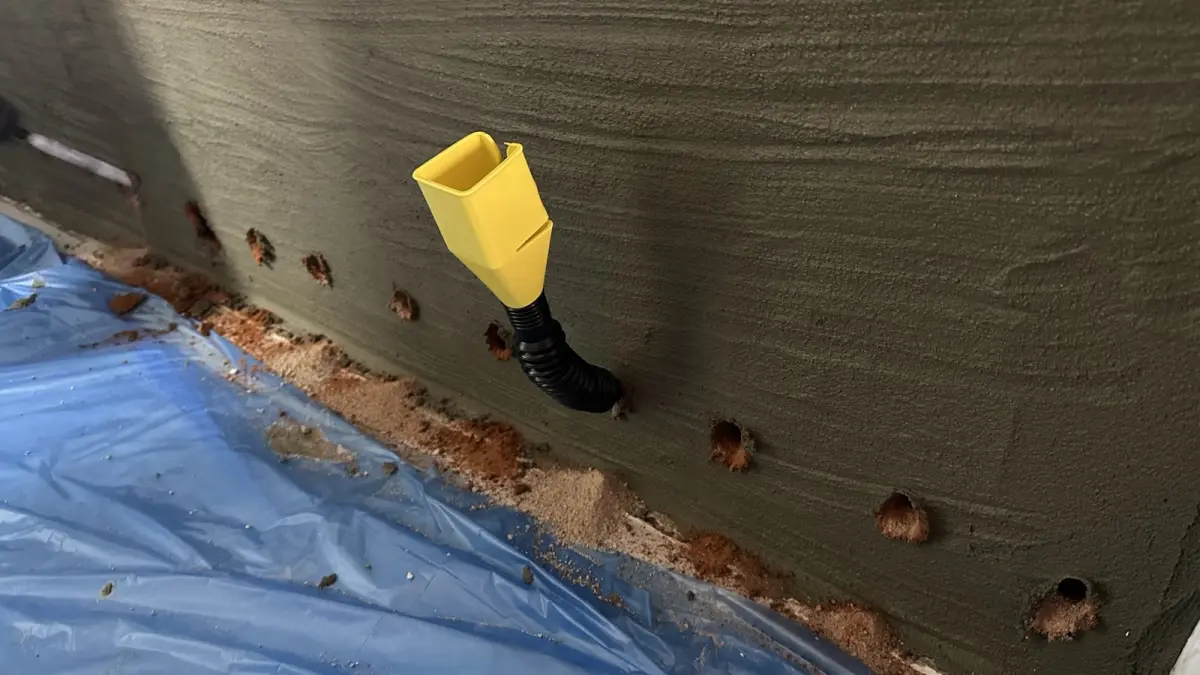
This is the method of cutting off the capillary path by forming a hydrophobic (water-repellent) layer on the inner surfaces of the pores with a chemical liquid injected into the wall. The DampStop + HydroFix system works on exactly this principle.
The silane/siloxane-based formula of DampStop bonds chemically to the pore walls and changes the surface energy. Pore surfaces that would normally form strong adhesive bonds with water become hydrophobic (water-repellent) after DampStop injection. In this case, the contact angle rises above 90 degrees and capillary rise becomes physically impossible.
An important point: the hydrophobic layer formed by DampStop does not block the pores. The pore channels remain open and allow the passage of water vapour. This enables the wall to "breathe" and allows the existing moisture to dry out by evaporating naturally. Only the rise of liquid water by capillary movement is prevented.
For detailed application instructions, you can read our How to Apply HydroFix? guide.
Experimental Evidence and Research
Cutting off the capillary path with the chemical injection method is an evidence-based solution method supported by international building science research.
European Standards
In the European Union, chemical DPC products are tested and certified according to the WTA (Wissenschaftlich-Technische Arbeitsgemeinschaft) guidelines. These tests assess to what extent the product prevents capillary rise, its compatibility with wall materials and its long-term durability. Silane/siloxane-based injection systems have shown high effectiveness rates in these tests.
Field Research
Long-term field research carried out by the United Kingdom's Building Research Establishment (BRE) has shown that the chemical injection method, when applied correctly, effectively stops rising damp. This research has revealed that wall moisture levels fall to acceptable levels within months after application and that this situation is maintained for many years.
Materials Science Perspective
Silane and siloxane compounds have been used in the protection of building materials for decades. These chemicals bond chemically (covalent bond) to porous surfaces and form a hydrophobic monolayer. Thanks to the covalent bond, this layer is extremely durable and is resistant to mechanical wear, UV light and chemical attack.
Conclusion
Capillary action is one of the fundamental physical laws of nature and, because of the porous structure of building materials, leads to the rising damp problem in buildings. The permanent solution to this problem requires the capillary path to be cut off physically or chemically.
The silane/siloxane-based formula of DampStop stops capillary rise by forming a hydrophobic layer on the inner surfaces of the pores. When used together with HydroFix damp-proofing plaster, a comprehensive system is obtained that both cuts off the capillary path and enables the wall to dry out healthily.
To learn about all aspects of the rising damp problem, you can read our What Is Rising Damp? guide, and to understand its health effects, our article Health Risks in Damp Environments.
A Scientific Solution to Capillary Damp
Calculate the amount of material suitable for your wall and take a step towards a permanent solution.