
Short answer: In basement, semi-basement, below-ground and retaining walls, water gets in actively, from outside. On these walls, DampStop (rising damp) injection is not the solution. HydroFix damp-proofing plaster keeps the problem out of sight for a while, but as long as water keeps getting in, the damp will show itself again later. To stop moisture and water in a basement, you need to move on to works such as polyurethane (PU) injection and crystalline waterproofing. These are application works planned on the basis of an expert assessment; the first step is to send photos using the free building information form.
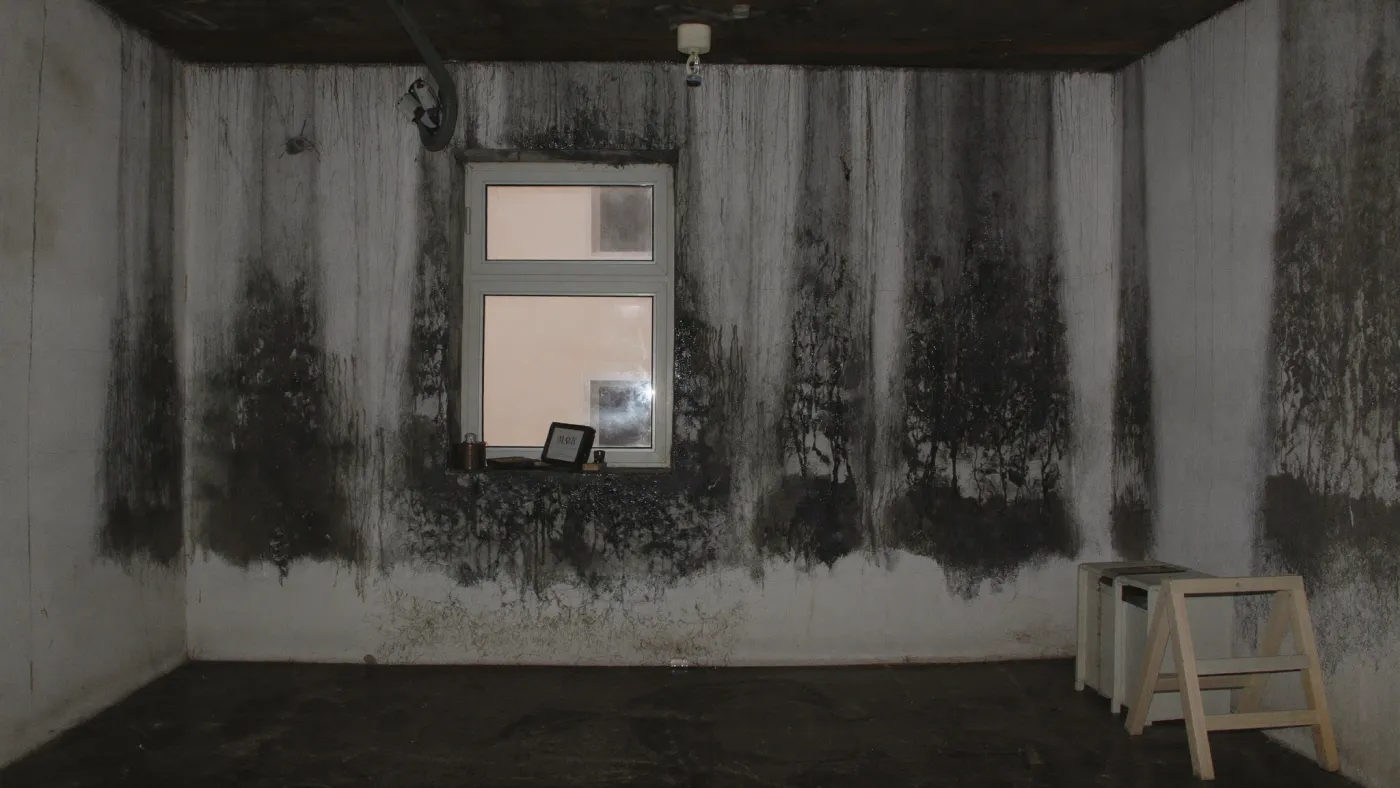
In a basement, salt marks at the base of the wall, blistering paint, mould and a heavy musty smell appear. Because the symptoms are the same as rising damp on the entrance or ground floor, the same solution is often applied: injection at the base of the wall and damp-proofing plaster on top. In a basement, however, the water takes a different path, and that difference changes the solution too. In this article we use an application section to explain where water gets into a basement, why injection and damp-proofing plaster are not enough here, and which works this job is done with.
The difference between a basement and the entrance/ground floor
The first question is whether there is soil behind the wall. If one face of the wall rests against soil, water reaches that wall from outside, continuously. If the wall is above ground and the damp appears in the lower part of the wall, the problem is most likely moisture rising from below.
| Situation | How does the water arrive? | What is done? |
|---|---|---|
| Basement, semi-basement, below-ground / retaining wall | From outside, actively: water in the soil reaches the concrete wall and the joint where the wall sits on the slab. | PU injection (E101 Pur In) + crystalline waterproofing (N102 Crystal 2K) works; planned on the basis of an expert assessment. |
| Entrance / ground floor (wall with no contact with the soil) | From below, rising by capillary action; in an exterior wall it can also get in horizontally at the base of the wall. | DampStop injection + HydroFix damp-proofing plaster; if needed, the triple system with the Damp Box (Nem Kutusu). |
Why is DampStop injection not the solution in a basement?
DampStop forms a barrier at the base of wall units (brick, aerated concrete, concrete block) and cuts off water rising from below. In a basement, however, water does not come from below; it gets in actively from outside, through the wall itself that rests against the soil and along the line where the concrete wall meets the slab. A rising damp injection at the base of the wall does not cut off this path. That is why we do not recommend DampStop for basement, semi-basement, below-ground and retaining walls.
What does HydroFix damp-proofing plaster do in a basement?
On a basement wall, HydroFix damp-proofing plaster keeps the problem out of sight for a while. But as long as water keeps getting in from outside, the damp will show itself again later. In other words, in a basement the damp-proofing plaster does not stop the water getting in; it only delays the symptom for a while. Knowing this from the start avoids wasted renovation costs.
Where does water get into a basement?
The line through which water most often gets into a basement is the joint where the concrete wall sits on the raft or foundation; this is called a cold joint. Water gets in through this joint and through the lower part of the concrete wall. Because this line is the source of the problem, the intervention is also made along this line: the joint is filled from the inside with PU injection, and the face of the concrete wall and the strip at the base of the wall are covered with crystalline waterproofing.
- Cold joint (concrete wall–raft junction): the line through which water most often gets into a basement.
- Dryvatec E101 Pur In: flexible PU injection that expands on contact with water; fills the joint from the middle of the section.
- Packer hole: at about 45° from the face of the concrete wall, crossing the joint in the middle of the wall; closed with R101 after the packers are removed.
- Joint channel: if there is active water, it is stopped with N111 Stop; the channel and the inner corner are given a 40×40 mm fillet with R101 Repair Mortar.
- Dryvatec N102 Crystal 2K: crystalline waterproofing, at least 2 coats; continuous on the face of the concrete wall up to the ceiling, over the fillet and onto the floor of the strip.
- Dryvatec R110 C-25 Ready-Mix Concrete: the broken-out strip is filled up to screed level.
- New floor finish: renewed only in the 30–40 cm strip.
- Wall plaster: removed over the full height; renewed after the waterproofing has cured.
- Existing screed and floor finish: not broken out, left as they are.
Application steps
The sequence below shows how the detail in the section is carried out on site. This is not a do-it-yourself application: packer spacing, the need to stop water and the limits of the break-out are decided on site by an expert, according to the water flow and the structure.
- Strip break-out: The floor finish and screed are broken out in a 30–40 cm wide strip at the base of the wall; the wall plaster is removed up to the ceiling. The rest of the floor is not touched.
- Joint channel and stopping water: A channel is cut along the cold joint and cleaned. If there is active water, it is stopped with Dryvatec N111 Stop.
- PU injection: The packers are set at an angle of about 45° so that they cross the joint in the middle of the section. Dryvatec E101 Pur In is injected from the bottom upwards until it comes out of the neighbouring packer.
- Fillet and hole filling: The packers are removed, and the holes and the channel are filled with Dryvatec R101 Repair Mortar; a 40×40 mm fillet is formed in the inner corner.
- Crystalline waterproofing: Dryvatec N102 Crystal 2K is brushed onto the water-saturated surface, on the face of the concrete wall up to the ceiling and onto the floor of the strip, in at least 2 coats at right angles to each other; it is kept damp for 3 days.
- Filling and floor finish: The strip is filled up to screed level with Dryvatec R110 C-25 Ready-Mix Concrete; the floor finish and the wall plaster are renewed over the full height.
Why two systems together?
E101 Pur In stops the water coming through the joint from inside the structure. N102 Crystal 2K, in turn, provides surface waterproofing by sealing the capillary pores of the concrete with crystals. One deals with the water path in the joint, the other with the face of the concrete wall and the floor of the strip.
Is the whole floor broken out?
No. Because water gets in through the joint where the concrete wall meets the slab, the intervention is made only in the 30–40 cm strip at the base of the wall; the rest of the existing screed and floor finish is kept. For example, in a 6.00 × 4.50 m (27 m²) room the area broken out is about 6.9 m², that is, about a quarter of the floor.
The crystalline coating is applied to the face of the concrete wall continuously, up to the ceiling. If the coating stops at half height, water comes out to the surface through the uncoated part.
What is done on the entrance and ground floor?
On entrance or ground-floor walls with no contact with the soil, if the damp appears in the lower part of the wall, the situation is different. Here DampStop injection cuts off water rising from below and HydroFix damp-proofing plaster repairs the wall surface. These two products work in wall units (brick, aerated concrete, concrete block). If there is damp throughout the building, or damp also appears at the base of columns and in reinforced concrete sections, the Damp Box is added: the Damp Box carries water reaching the foundation and rising in the columns back into the ground. Together, the three make up the Dryvatec triple system.
In an exterior wall, water can also get in horizontally beneath the brick; in that case the screed at the base of the wall is removed and HydroFix is taken down to the junction with the foundation concrete/slab. Details: Damp entering at the base of an exterior wall. If the wall takes in water from outside, from rain or through the facade: What to do about a wall letting in water from outside?
Signs of damp in a basement
- Salt efflorescence: Water carries the salts in the concrete or plaster to the surface and leaves white marks.
- Blistering and flaking paint and plaster: Moisture coming from behind the wall separates the coating from the surface.
- Wet patches and seepage: Wetness at the base of the concrete wall or along the joint line is a sign of active water ingress.
- Mould and a heavy musty smell: Felt more strongly in closed, poorly ventilated basements.
The right step for a basement: an expert assessment
PU injection and crystalline waterproofing are not a job that ends with buying the product and applying it; they are works planned after assessing on site the line where water gets in, the water flow, and the condition of the wall and the slab. Send photos of your basement from inside (the base of the wall, the concrete wall–floor junction, wet areas) and, if possible, images taken on a rainy day, using the free building information form; our technical team will assess them and get back to you.
Can a Garden-Level or Retaining Wall Be Waterproofed from Inside?
One of the most common cases on our WhatsApp line: customers living on a garden level or in a semi-basement, with soil behind the wall, who ask "can we insulate from the inside?" Since digging outside is impossible for most buildings, it is a very reasonable question.
Yes, it is possible — but not with plaster or paint. On concrete retaining and basement walls in contact with the ground, water comes from outside under pressure, so the work inside must block it: running water is first stopped with N111 Stop water plug, cracks and joints are filled with PU injection, and the surface is coated with crystalline waterproofing. Crystalline material forms crystals in the pores of the concrete and stops the water, which is why it is one of the few methods that can be applied from the inside (negative side). Damp-proofing plaster or waterproof paint only hides the problem for a while on these walls.
These jobs need professional application. An on-site survey is chargeable and planned by region: our own application team works in Istanbul and Izmir, our application partners cover the Kuşadası and Antalya areas, and other regions are assessed by our team. Details: Do you offer on-site surveys?
Frequently Asked Questions
Can a concrete retaining wall be waterproofed from the inside?
Yes, but not with plaster or paint. Running water is stopped with a water plug, cracks are filled with PU injection and crystalline waterproofing is applied to the surface; crystalline material is one of the methods that can be applied from the inside (negative side). This needs professional application; an on-site survey is chargeable and planned by region.
Is DampStop injection used on a basement wall?
No. DampStop is for moisture rising from below. In basement, semi-basement, below-ground and retaining walls, water gets in actively from outside; on these walls DampStop injection is not the solution. In a basement you need to move on to works such as PU injection and crystalline waterproofing.
Does HydroFix damp-proofing plaster work in a basement?
On a basement wall, HydroFix keeps the problem out of sight for a while. But as long as water keeps getting in from outside, the damp will show itself again later. In a basement, the water ingress must be stopped first.
How are moisture and water stopped in a basement?
Water mostly gets in through the cold joint where the concrete wall sits on the raft and through the lower part of the concrete wall. The joint is filled with Dryvatec E101 Pur In polyurethane injection, and the face of the concrete wall up to the ceiling and the strip at the base of the wall are covered with Dryvatec N102 Crystal 2K crystalline waterproofing. These works are planned on the basis of an expert assessment.
Is the whole floor broken out to waterproof a basement?
No. The intervention is made only in the 30–40 cm wide strip at the base of the wall; the rest of the existing screed and floor finish is kept. After the application, the strip is filled with R110 C-25 ready-mix concrete and the floor finish is relaid.
What is done about damp on the entrance or ground floor?
On entrance and ground-floor walls with no contact with the soil, DampStop injection and HydroFix damp-proofing plaster are applied against moisture rising from below. If there is also damp throughout the building or at the base of columns, the Damp Box is added, which carries water reaching the foundation and rising in the columns back into the ground; together, the three make up the triple system.
What should the first step be for damp in a basement?
Send photos of the base of the wall, the concrete wall–floor junction and the wet areas using the free building information form. The technical team will assess the water's path and the works needed and get back to you.
Related Guides
- Damp entering at the base of an exterior wall: why is the screed removed?
- What to do about a wall letting in water from outside?
- What is the Damp Box and how does it work?
- The Dryvatec Triple System: DampStop + HydroFix + Damp Box
- PU injection waterproofing materials
- Crystalline waterproofing materials
Where is water getting into your basement?
Send photos of the base of the wall and the concrete wall–floor junction; we will assess the water's path and the works needed free of charge.