
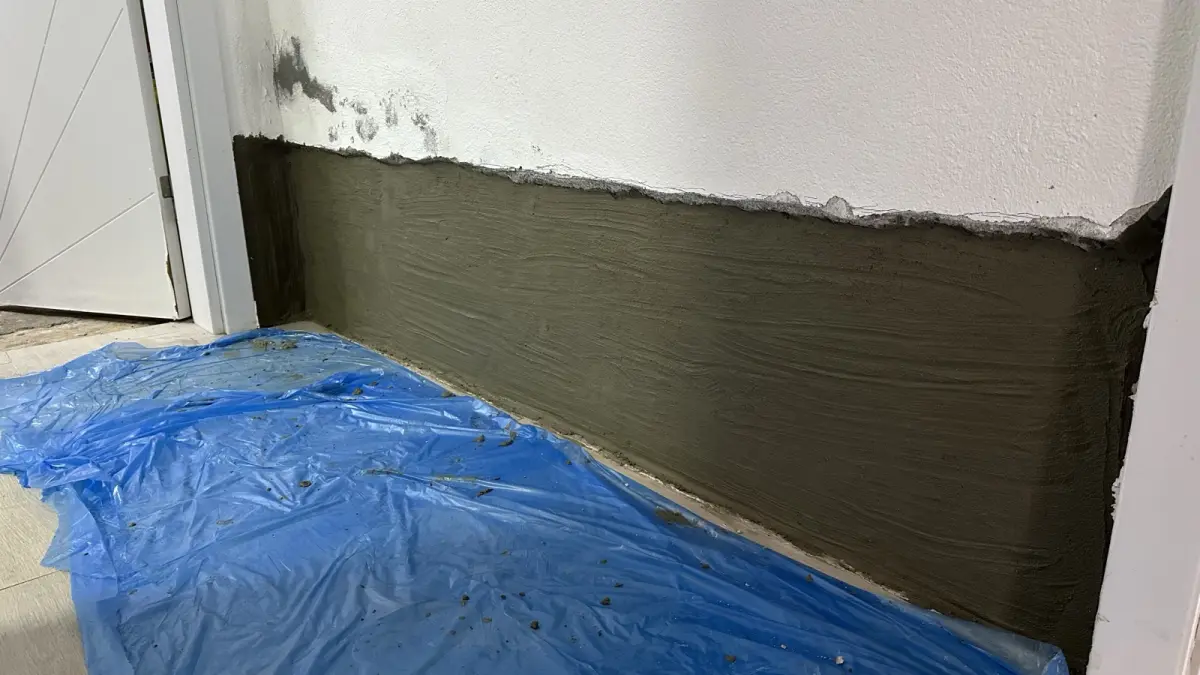
Short answer: In a damp repair, HydroFix damp-proofing plaster is applied on the wall face down to the floor junction; the gypsum plaster on top, however, is applied only up to skirting height and is not taken down to the floor or the screed. This is because gypsum plaster can carry moisture and damp from the screed upwards. The section between where the gypsum plaster ends and the floor is covered by the skirting board.
When a damp wall is repaired, most of the effort goes into the damp-proofing plaster and the injection. But the job can also go wrong at the final coat, the gypsum plaster. If the gypsum plaster is habitually pulled down to the floor and made to touch the screed, a layer that can carry moisture back upwards has been added on top of all the damp measures taken at the base of the wall. In this article we explain the rule, the reason for it and the right order of work with a cross-section drawing.
The rule: damp-proofing plaster to the joint, gypsum plaster to skirting height
The two layers at the base of the wall end at different points:
- HydroFix damp-proofing plaster: Applied over the whole wall face, down to the floor junction. On exterior walls, the screed at the base of the wall is removed and it is taken down to the junction with the foundation concrete/slab (details: Damp entering at the base of an exterior wall).
- Gypsum plaster: Applied over HydroFix only up to skirting height. It is not taken down to the floor junction or the screed.
- Skirting board: Covers the section between where the gypsum plaster ends and the floor.
| Layer | How far down? | Why? |
|---|---|---|
| HydroFix damp-proofing plaster | On the wall face down to the floor junction (on an exterior wall, with the screed removed, down to the junction with the foundation concrete/slab) | This is the breathable layer that deals with the base of the wall and with water that may come through the joint. |
| Gypsum plaster | Only up to skirting height | If it touches the screed, it can carry moisture and damp from the screed upwards. |
| Skirting board | Between the end of the gypsum and the floor | Covers the gap. |
Why? Gypsum plaster can carry moisture up from the screed
Screed is a layer that sits on the floor structure and can hold moisture. When gypsum plaster touches the screed, it can carry moisture and damp from the screed upwards by capillary action. In that case, even if the injection and damp-proofing plaster at the base of the wall are intact, moisture rises through the gypsum plaster; blistering paint, staining and mould can reappear at the base of the wall.
When the gypsum plaster ends at skirting height, its contact with the screed is broken. Below skirting height only HydroFix remains on the surface; HydroFix is a cement-based, breathable damp-proofing plaster and contains no gypsum.
The right order of work
- Remove the damaged plaster: The damp plaster and the skirting board are removed and the mineral surface is exposed. On exterior walls, the screed at the base of the wall is also removed.
- Apply HydroFix down to the floor junction: Two coats, each 2–2.5 mm thick. Details: How to apply HydroFix.
- DampStop injection if needed: If moisture is rising from below, holes are drilled once HydroFix has dried and DampStop is applied. The injection comes after the plaster because stripping plaster can break open the cells of the bricks; if you inject first, the solution runs out through those breaks. If the plaster goes on first, the injection stays inside the brick without overflowing. Details: Damp injection application guide.
- Screed and floor: The removed screed is renewed and the floor finish is laid.
- Mark skirting height: The line where the gypsum plaster will end is set according to the top edge of the skirting board to be fitted.
- Stop the gypsum plaster at this height: The gypsum is applied over HydroFix once it has dried and is cut off at skirting height; it is not taken further down towards the screed.
- Fit the skirting board: The section between where the gypsum ends and the floor is covered by the skirting board.
- Breathable paint: Primer and a vapour-permeable paint; plastic or oil-based paint is not recommended. Details: How to paint a damp wall.
Common mistakes
- Pulling the gypsum plaster down to the screed: Gypsum can carry moisture from the screed upwards; the damp measures taken can be wasted.
- Stopping the damp-proofing plaster halfway and taking the gypsum down: This reverses the order: what belongs at the base of the wall is HydroFix, not gypsum.
- Applying HydroFix over gypsum: HydroFix is not applied to gypsum, paint or tiled surfaces; the mineral surface must be exposed first.
- Thinking about skirting height afterwards: If the height is not set in advance, the gypsum either stops short or ends up reaching the screed.
- Plastic or oil-based paint: It blocks vapour; breathable paint should be used.
Products for this application
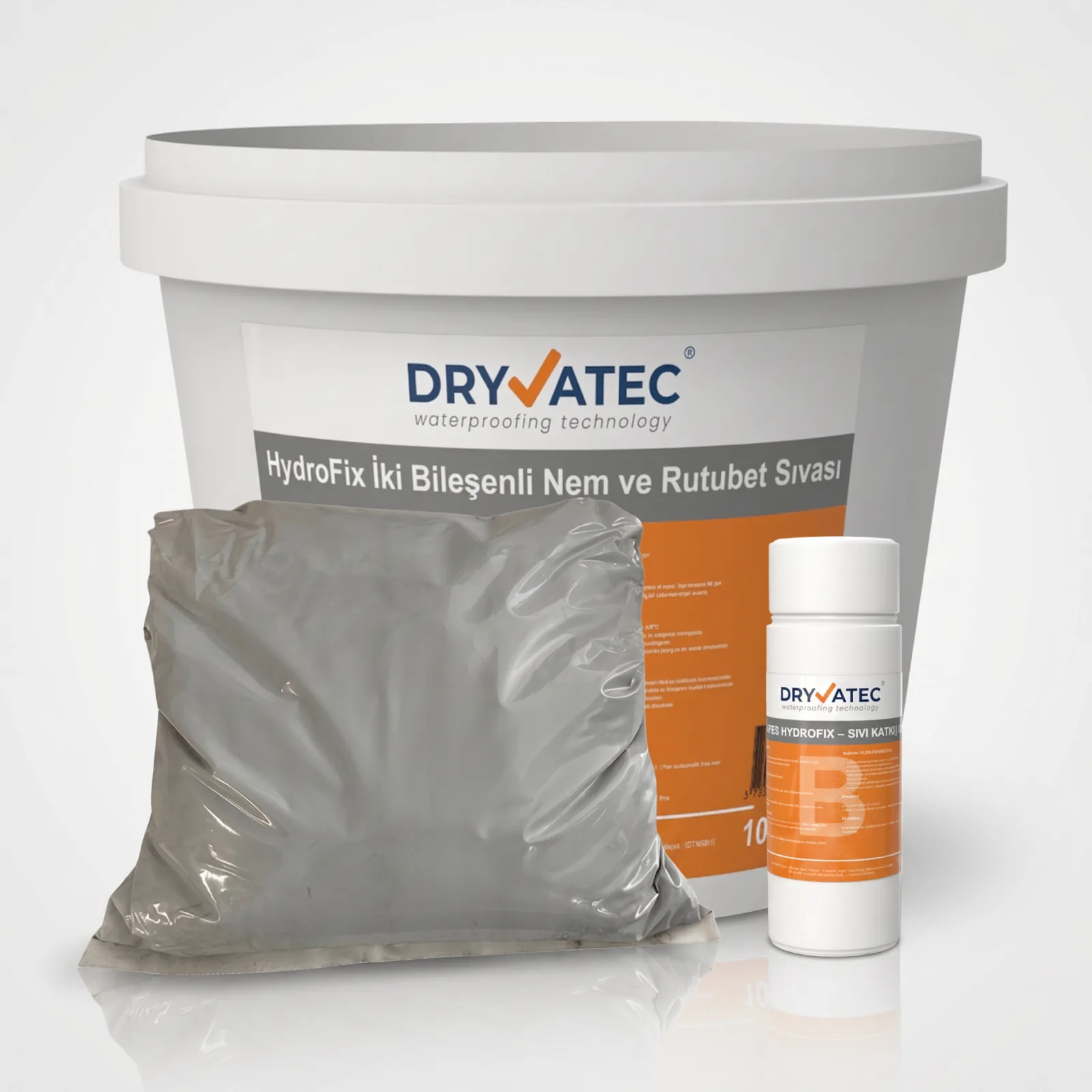
HydroFix 10kg Damp-Proofing Plaster
Cement-based, breathable interior damp-proofing plaster applied down to the floor junction. 10 kg covers about 4.5–5 m² in a single coat.
1.500₺ incl. VAT View Product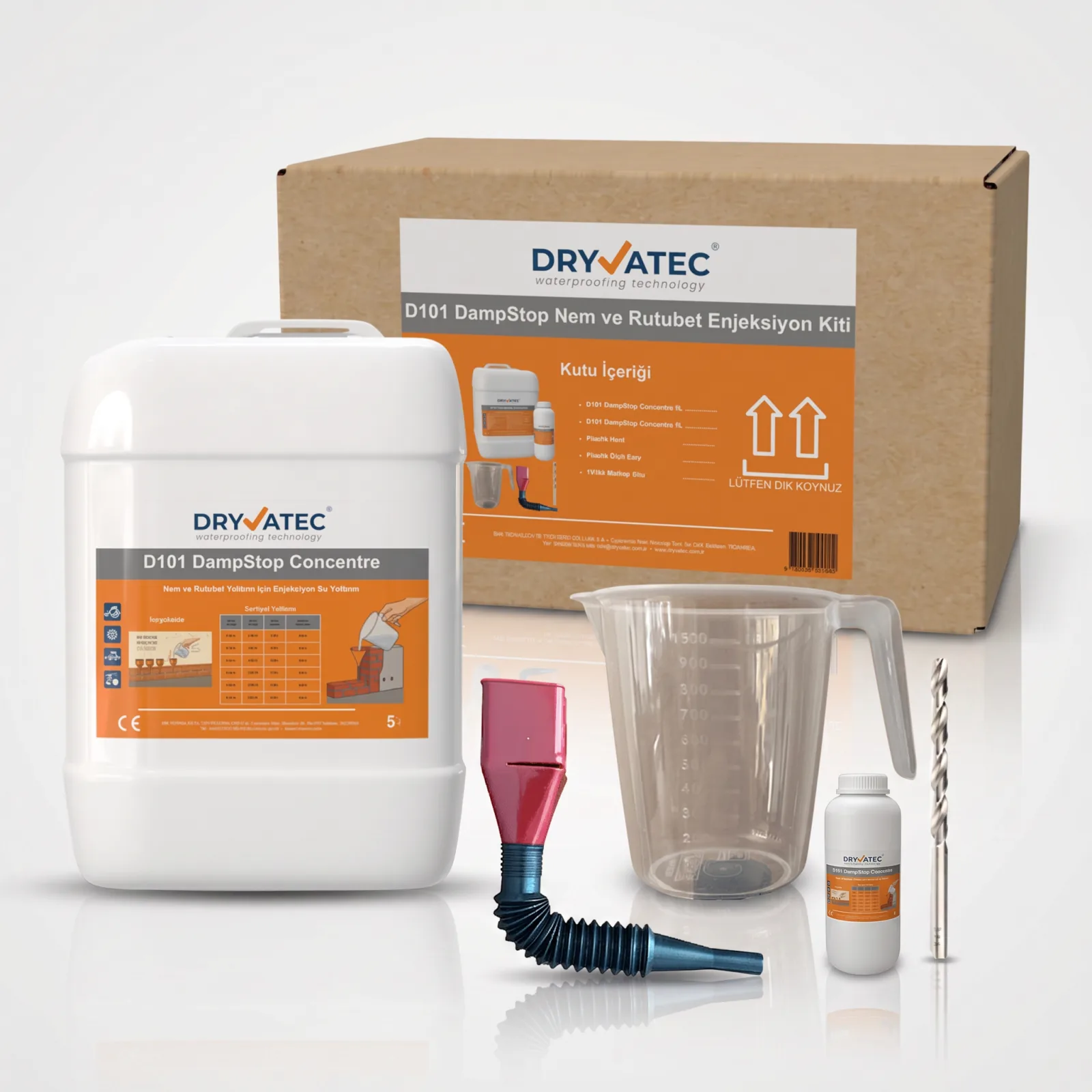
DampStop Complete Kit
Injection pack if moisture is rising from below: 5 L concentrate + funnel + measuring cup + 14 mm drill bit. HydroFix is not included in the kit and is bought separately.
8.700₺ incl. VAT View ProductPay by card (Ziraat 3D Secure) or bank transfer/EFT — for bank transfer call +90 850 532 6 999 · No cash on delivery or instalments · Free shipping within Türkiye · 14-day right of return · Work out the quantity with the consumption calculator. How the three products work together: Triple System.
Frequently Asked Questions
Why is gypsum plaster not taken down to the floor?
When gypsum plaster touches the screed or the floor, it can carry moisture and damp from the screed upwards. That is why gypsum plaster is applied only up to skirting height; the gap is covered by the skirting board.
What does skirting height mean?
It is the height the skirting board reaches on the wall, that is the level of its top edge. The gypsum plaster ends at this level; the section below it is covered by the skirting board.
Which layer is left behind the skirting board?
Below skirting height, HydroFix damp-proofing plaster remains on the wall face. HydroFix is applied over the whole wall face down to the floor junction; the gypsum plaster is applied over it only up to skirting height.
Can gypsum plaster be applied to a damp wall?
Gypsum plaster is not a damp measure. First, the solution matching the source of the moisture is applied: for moisture rising from below, DampStop injection and HydroFix damp-proofing plaster on the wall face. Gypsum plaster is applied over these layers, up to skirting height.
Does HydroFix contain gypsum?
No. HydroFix is a cement-based, polymer-modified, two-component damp-proofing plaster; it contains no gypsum. Nor is it applied to gypsum, paint or tiled surfaces.
Related Guides
- Damp entering at the base of an exterior wall: why is the screed removed?
- How to apply HydroFix
- Damp injection application guide
- What to do about a wall letting in water from outside
- What is capillary action?
- Covering a damp wall: plasterboard, panelling, wallpaper?
Let's plan the right order before your renovation
Send photos of the wall and the base of the wall; we will assess free of charge which layer should go how far.